Use a Multiplication Chart for Fact Fluency
Why the chart should help practice instead of replacing it
A multiplication chart is useful because it makes the whole fact family visible at once. Students can see rows, columns, repeated products, and number patterns that stay hidden when they only hear facts one at a time.
The problem starts when the chart becomes the only way to answer. If a learner checks every fact by staring at the full grid, the chart stops being a support and starts doing the work for them.
A better goal is to use the chart as a bridge. It should help students notice structure first, then move toward steadier recall. For that kind of practice, the multiplication chart works best when it is part of a short routine instead of a permanent answer key.
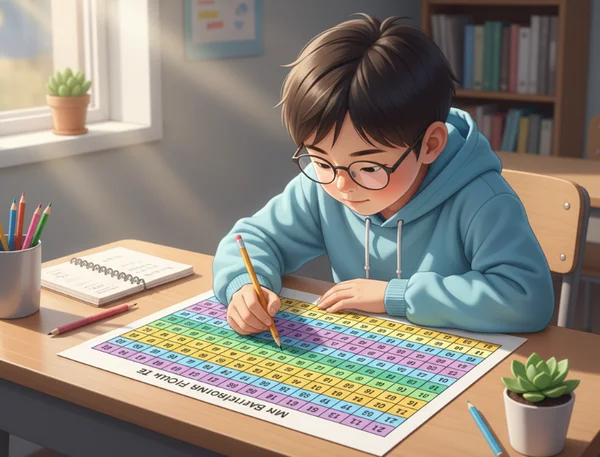
What a multiplication chart helps students notice
Visual patterns before memorized answers
Before a fact feels automatic, it often helps to see it. The Institute of Education Sciences What Works Clearinghouse guide covers math problem solving in grades 4 through 8. One recommendation is to teach students how to use visual representations. That matters here because a multiplication chart is exactly that: a visual way to organize facts.
A chart helps students notice that 3 rows of 4 and 4 rows of 3 land on the same product. It shows that the 5s line ends in 0 or 5, that the 10s line adds a zero, and that the square numbers sit on a clear diagonal. Those patterns reduce the feeling that every fact is random.
This is especially helpful for learners who freeze when they try to memorize everything at once. The chart gives them something to look at, compare, and talk through before they are asked to recall from memory.
How rows and columns connect to fact language
The same IES guide on mathematical problem solving also recommends helping students recognize and articulate mathematical concepts and notation. In chart practice, that means connecting what a student sees to what they say and write.
For example, a learner can point to the 6 row and say, "This row shows what happens when 6 is multiplied by 1, then 2, then 3." They can trace one box and say, "6 times 4 equals 24." That small shift matters. The chart is no longer just a picture. It becomes a map for speaking facts clearly.
Rows and columns help with this because they give practice a shape. A student can stay with one table, notice how products grow, and use repeated language until the pattern feels familiar. That is easier than jumping across the grid with no plan.
How to move from looking to recalling
Start with one row, one column, or one table
The easiest way to move toward fluency is to make the task smaller. Pick one row, one column, or one times table instead of the whole chart.
This keeps practice focused. A student working on the 4s does not need to stare at every fact from 1 to 12. They need a small set they can read, say, and check more than once in the same session.
A simple routine works well:
- Read one row from left to right.
- Say each fact out loud.
- Cover the row and try 2 or 3 facts from memory.
- Reopen the chart and check only the missed ones.
That cycle keeps the chart involved, but only as support. It also helps adults see where the learner is really stuck instead of assuming the whole chart is equally difficult.
Cover, answer, and check without pressure
Once one row or table feels familiar, start hiding part of the support. Cover one product, answer it, and then check. Cover two boxes, answer them, and then check again. This is a calmer step than removing the whole chart at once.
The point is not speed on day one. The point is accurate recall with enough support to keep confidence steady. When students know they can uncover the answer and confirm it right away, they are more willing to try.
This is also where adults can keep the tone helpful. Instead of saying, "You should know this already," say, "Let's see which ones still need the chart." That keeps practice about progress, not pressure.
If you want a clean visual for that routine, the times table chart helps because it keeps the facts in one place. You can decide what to show and what to cover without changing tools.

When to keep the chart open and when to hide it
Warmups and guided practice with the full chart
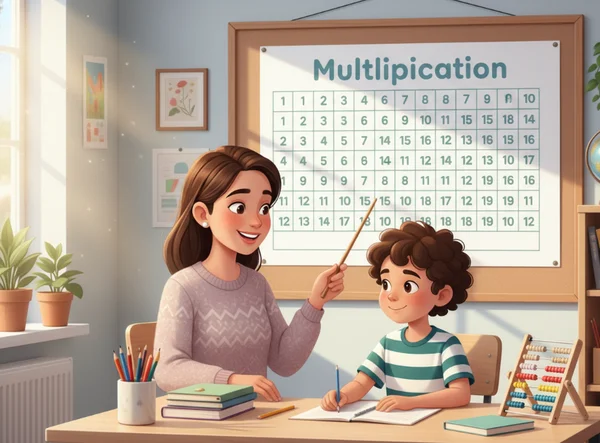
The full chart still has an important job. It is useful during warmups, teacher modeling, and short guided review before independent recall begins.
That matches how official resources frame fluency work. The Ohio Department of Education and Workforce mathematics resources page includes "Building Fact Fluency with Multiplication and Division in Grades 3-5." That is a good reminder that fact fluency is built through structured practice, not through one sudden jump away from support.
In practical terms, keep the chart open when you are introducing a new table, reviewing patterns, or helping a student explain how they found an answer. Use the full grid to spot doubles, diagonals, and repeated endings. Then narrow the focus once the learner knows where to look.
This is where the chart practice page can help most. Use it for a 3-minute warmup, a quick pattern check, or a guided review before the student tries recall on their own.
Independent recall after the pattern is familiar
Hide more of the chart once the pattern is familiar enough to describe without staring at every box. That is the signal that the learner is ready to do more remembering and less searching.
You do not need to remove support all at once. Start by hiding one row, then one column, then the whole chart for a short burst of recall. Bring it back only to check. This creates a clean difference between "I am learning the pattern" and "I am testing what I remember."
Independent recall also works better when the session is short. Five calm facts checked well are better than twenty rushed guesses that end in frustration.
What to do next after the chart
Once a student can read one table, cover part of it, and recall several facts correctly, keep the next step small. Stay with that table for another round before jumping to the entire grid.
Then rotate between three actions: look, say, and recall. Look at the row to notice the pattern. Say the facts to connect the chart to math language. Recall a few products without looking. That three-part rhythm helps the chart teach instead of replace the learning.
The long-term goal is simple. Students should not feel trapped by the chart, and they should not lose confidence the moment it disappears. A steady fade from visual support to recall gives them a much better chance of building lasting times table fluency. For a simple place to begin that process, the visual table guide keeps the chart front and center without turning practice into guesswork.