Interactive Multiplication Charts: Learn in 20+ Languages
Does math feel like a universal language until you have to explain it to a child in a different tongue? For parents, teachers, and students around the globe, teaching essential skills like multiplication can become challenging when educational resources don't speak your language. This can create unnecessary hurdles in a child’s learning journey.
What if learning multiplication could be simple and clear, no matter what language you speak at home?
With our interactive tool, we believe that language should never be a barrier to quality education. Our platform offers a powerful, interactive multiplication chart designed to support learners from diverse backgrounds. Click to switch between 20+ languages. It turns confusion into fun, intuitive learning. Let's dive in and see how you can use our free tool to build your child's multiplication skills—step by step. You can explore our tool right now.
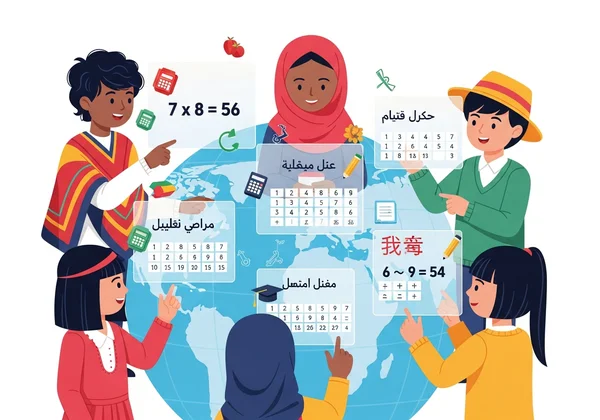
Navigate Your Multilingual Multiplication Chart with Ease
Our core mission is to make learning multiplication as straightforward as possible. That's why we designed our interactive chart to be incredibly user-friendly, especially for families and classrooms that use more than one language. Getting started is simple, allowing you to focus on what truly matters: learning.
Switching Languages: A Simple Step-by-Step Guide
You can access our multiplication tools in your preferred language in just a few seconds. There's no complex menu to navigate or account to create.
- Visit the Homepage: Head to the homepage. You will immediately see the interactive multiplication chart.
- Locate the Language Menu: On the side of the page, you will find a language selection menu. It's clearly marked and easy to find.
- Choose Your Language: Click on the menu and scroll through the list of over 20 supported languages. Select the one you need, whether it's Spanish, French, Arabic, Mandarin, or Hindi.
- Watch the Magic Happen: The entire interface, including the multiplication equations that appear, will instantly switch to your chosen language.
This seamless transition ensures that students can learn in the language they are most comfortable with, reducing confusion and building a strong foundation.
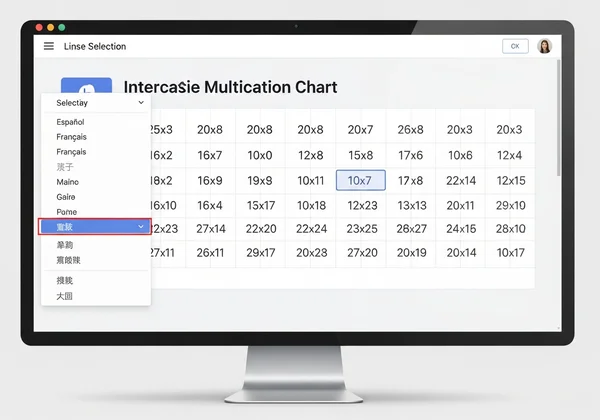
Interacting with the Chart: Instant Results in Your Native Tongue
The real power of our tool lies in its interactivity. Once you've selected your language, the learning experience becomes fully immersive. When you or your child hover the mouse over any number on the grid, the corresponding row and column light up.
Best of all, the full problem—like "7 x 8 = 56"—pops up below the chart. It's in your chosen language. This immediate feedback is crucial for reinforcing memory. A child learning in German will see "7 x 8 = 56," while a student in Japan will see "7 x 8 = 56." The numbers are universal, and now, so is the instruction.
Downloading Printable Charts for Offline Learning in Any Language
We understand that learning isn't confined to a screen. That's why our platform bridges the gap between digital and physical learning. You can easily download and print our multiplication charts for offline practice.
These printable versions are perfect for:
- Classroom handouts and quizzes.
- Homework assignments without screen time.
- Practice sessions during travel.
- A handy reference guide taped to a wall or desk.
Just like our interactive tool, these resources are available in all supported languages. This feature allows parents and teachers to provide consistent, multilingual support whether the student is online or offline. You can download your chart for free anytime.
The Power of Visual Learning Across All Languages
Why is an interactive, visual tool so effective for teaching math globally? The answer lies in how our brains process information. Visual learning transcends language barriers and helps students grasp abstract concepts more easily. Numbers and patterns are universal, and a visual chart makes these connections clear.
Breaking Down Language Barriers with Universal Math Patterns
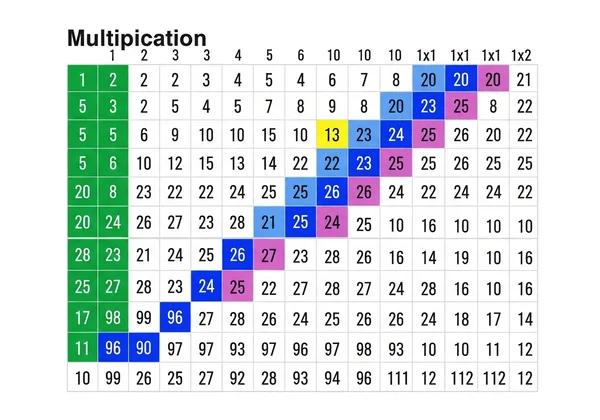
A multiplication chart is more than just a grid of numbers; it's a map of mathematical patterns. With our unique color-highlighting feature, students can visually explore these patterns themselves.
For example, a child can use a color to mark all the answers in the 5s column and see that they all end in 5 or 0. They can highlight the diagonal line of square numbers (1x1, 2x2, 3x3) and see a clear visual pattern emerge. This discovery-based learning is powerful because it doesn't rely on complex verbal explanations. The student sees the logic, which is an understanding that sticks, regardless of their native language.
Building Confidence for ESL and Multilingual Students
For students learning in a language that is not their first, such as English as a Second Language (ESL) learners, math class can be doubly challenging. They have to process both a new language and new mathematical concepts at the same time. This can lead to anxiety and a lack of confidence.
Our multilingual tool helps solve this problem. As a parent, I've seen this work firsthand. My own child, who speaks Spanish at home, struggled with math terms in English. We used this exact method, and seeing that "aha!" moment when the concepts clicked was incredible. Start in their native language to grasp multiplication basics. Once confident, switch to English. It builds a strong bridge between the two, reducing cognitive load and empowering students to participate more confidently in class.
Global Reach: Explore Our Language Support
We are proud to offer one of the most comprehensive multilingual multiplication tools available online, completely free of charge. Our commitment to accessibility is reflected in the wide range of languages we support, ensuring that children from nearly every corner of the world can benefit.
A Comprehensive List of Supported Languages for Your Convenience
Our platform is constantly growing, but we currently support over 20 major world languages. This means there's a very high chance you'll find the one you need for your home or classroom. Some of the languages available include:
- English (en)
- Spanish (es)
- French (fr)
- German (de)
- Simplified Chinese (zh)
- Traditional Chinese (zh-TW)
- Japanese (ja)
- Korean (ko)
- Arabic (ar)
- Russian (ru)
- Portuguese (pt)
- Hindi (hi)
- And many more!
Free & Accessible: Quality Math Education for Everyone, Everywhere
Real equity means removing barriers. Our core principles are simple: our tool is always free, with no sign-ups and no ads. Every feature, from the interactive chart to the printable PDFs, is 100% free to use for everyone, everywhere.
This commitment ensures that parents and teachers, regardless of their economic situation or location, have access to a high-quality, safe, and effective educational resource. Our clean, distraction-free interface allows children to focus purely on learning.
Tips for Parents and Teachers in Multilingual Households
If you are supporting a child in a multilingual environment, our tool can be a fantastic ally. Here are a few tips to maximize its benefits:
- Start with the Familiar: Begin by setting the chart to the child's native language. Let them play, explore, and build a solid understanding of multiplication facts.
- Bridge the Languages: Once they are confident, introduce the school's language (e.g., English). You can switch back and forth, asking them to find "four times five" in both languages.
- Use Printables for Reinforcement: Print two charts—one in each language—and place them side-by-side. This creates a powerful visual reference that reinforces vocabulary and concepts simultaneously.
By using these simple strategies, you can turn a potential learning challenge into a unique advantage. Feel free to try these tips on our interactive chart today.
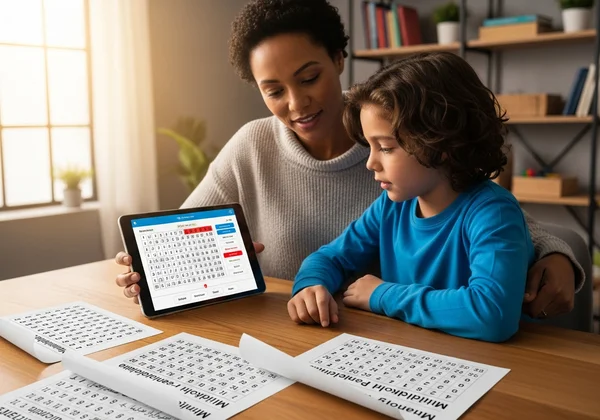
Empower Global Learners: Your Multilingual Path to Multiplication Mastery
Learning multiplication is a milestone in every child's education, and language should never stand in the way. With an interactive, visual, and multilingual tool, you can break down barriers and make math accessible and engaging for students everywhere. By providing instant feedback in over 20 languages and combining it with powerful offline resources, our tool empowers both educators and learners.
Picture your child nailing their times tables—let's make it happen today with our chart.
Visit our interactive chart now to explore our free printables and unlock a world of learning without limits.
Frequently Asked Questions About Multilingual Multiplication Charts
What is a multiplication chart and how does it help diverse learners?
A multiplication chart is a grid that shows the products of two numbers. For example, by finding where row 6 and column 7 meet, you find the answer to 6x7, which is 42. It helps diverse learners because it is highly visual. Instead of just memorizing text, students see numerical patterns and relationships. This visual method of understanding works across all languages and cultures.
How can I effectively use an interactive multiplication chart in a language other than English?
Using our chart in another language is simple and effective. First, select your desired language from the menu on our homepage. Then, encourage your child to explore the chart by hovering over different numbers. The tool will display the multiplication equations and answers instantly in that language. This immediate, native-language feedback helps reinforce concepts quickly and accurately.
What are the easiest ways to help my child learn multiplication if English isn't their first language?
The best approach is to build their core understanding in their strongest language first. Use our tool in their native language so they can master multiplication facts without the extra pressure of translation. Once they are confident, you can switch the tool to English to help them learn the corresponding mathematical terms. You can also find your language and download printable charts for consistent practice away from the screen.